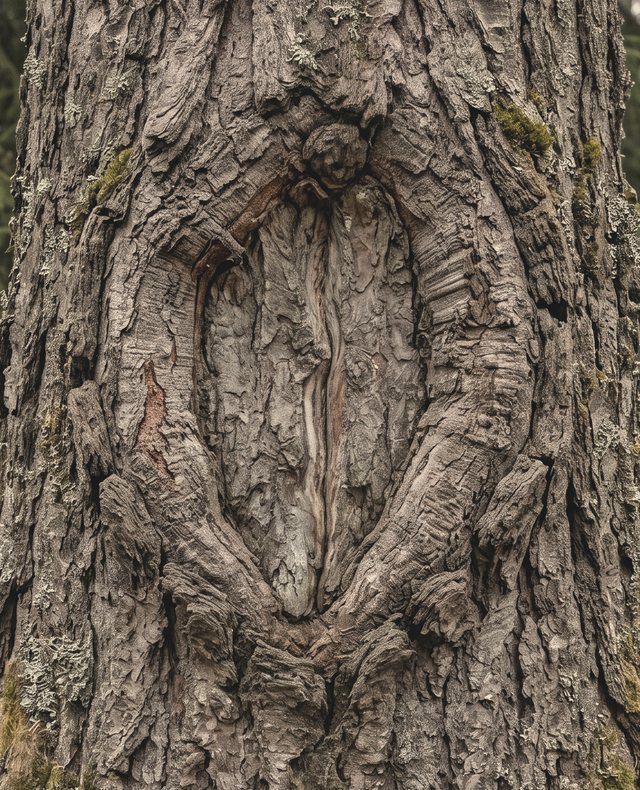
A tree records every year of its life, one ring at a time, and it never leaves the bad ones out. This is a year of my work drawn the same way — one ring for every month.
Tervik · 6 August 2026
I was born and raised around nature. Forestry is the family craft — my father is still out in it today, at an age when most people have long since stopped, doing work that does not care how anybody feels about it that morning.
A tree is the slowest argument I know.
My father taught me to read the rings on a stump before he taught me anything about growing one.
I was a small and fairly annoying kid at the time. My job was branches — spruce, pine, birch, whatever the felling left. You lay them down in a mat so the machines can ride over soft ground without sinking in and turning it up, and you stack the walls of brush, the slash, along the road higher than a kid stands. I remember throwing the big branches up two metres to top them, in between dragging logs out to the roadside for the tractor to take. The road itself was built out of the offcuts.
Nothing in a forest arrives finished. Nothing gets there by being described well, or planned hard enough, or believed in loudly. You put in a season. Then you put in another one. Years later the proof is a thing you can put your hand on.
Slow is not still — we just don't speak the language it happens in. When the wind leans on a spruce, the tree answers — it lays denser wood where the load lands, so the stem can take the next season's weather. Every dry week, every crowded summer, every neighbour that falls and lets the light in: all of it is written into the rings — not to record the year, but to be ready for the next one.
A year of that comes out as a band thinner than a fingernail. That is the whole output, and you could miss it.
Every forest keeps a diary. You just have to learn how to read it.
And it does not tidy the damage away. A branch torn off, a machine too close, fire up one side — a tree has no way to heal over and forget. It grows around the wound and carries the shape of that bad afternoon inside the trunk for the rest of its life.
Sealed over, never removed — decades after the damage.
It never hides it, and it never apologises for it. The scar is load-bearing. That trunk is still standing thirty years later with the worst day of its life sitting in the middle of it — and anyone who knows how to read the rings learns more from the injuries than from the easy years. We don't audit a tree for anything other than its health.
A record with the hard parts taken out is not a cleaner record. It is just insecure.
So I drew the work the only way I was ever taught to read anything: as a trunk keeping score.
One ring for each month the work has been alive. Not what it earned. Not what it cost. Only the work that went into it.
Scroll, and it grows.
uncounted counted, commit by commit
A record begins the day someone decides to keep one. Everything before that is testimony.
A tree's record is physical. We have been writing our records on trees all along: pulped into paper, they carried our knowledge for millennia. In my field that ends as case files that get written and, too often, forgotten — and shredder bags nobody mourns. Trees have done their time as paper.
A program's record is social: what staff write down, what gets delayed, what gets left out. And a program ends up accountable to whatever its record captures — capture only the billing and the liability, and quietly that becomes what the program is for. The trunk is not only a picture of my work. It is the design test for the systems I build.
The people these programs serve are already capable of growing — what they are usually handed is a system that hovers, removes every risk, and writes their year up for them two months late in language they would not recognise. I believe those systemic issues exist because protective human nature takes over in the absence of proper structure — the hovering is what care looks like when the system gives it nothing better to do.
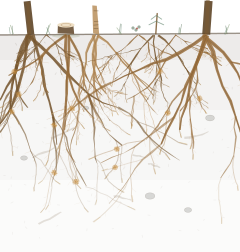
What they need is a foundation they never see. In an old forest the strength is not only in what stands. Roots of neighbouring trees fuse — two trees becoming one root system, holding the same ground. Cut one down and its roots do not necessarily die: the trees around it keep them fed, and the old root-plate goes on holding the hill. Nothing out there starts from zero. Those were the roots my branch roads were protecting — before I knew there was anything down there worth protecting.
A good system works like those fused roots. It holds the ground under people.
Picture a hard month that was real: goals missed, a plan that did not hold, a week that went sideways. In too many programs the response is to smooth it. The note arrives late, in someone else's voice, already cleaned for the file. A tree writes while it grows; nothing is written up afterwards. The person who lived the month cannot recognise themselves in it — and neither can anyone trying to help them grow past it. What if that month stayed visible long enough to be examined, in language that still belonged to them, and the growth afterwards was allowed to stand on it?
Take away every consequence and you take away the information a consequence carries. What actually builds a person is small failures, close together, with good questions afterwards.
So the system carries the accountability, and the person gets the room.
Enough structure that somebody can afford a hard month, and a record straight enough that one bad month never gets to be the whole story.
What I am after is not exposure, and not a wall of dashboards. A record that does not sand the scar off — where examining what went wrong is ordinary. The objection is always that transparency costs you strength; the trunk settled that thirty years ago.
This drawing regenerates every month. In a year it will carry rings I have not seen, and I will not get to choose a single width.
A spruce adds one circle of branches — a whorl — each year. This one has added a whorl for every month of the work — the same months the trunk above counts as rings.
My father is still out there this morning. Forestry runs on a clock longer than the person working it — you tend what somebody before you planted, and you leave behind trees you will not see full-grown.
When a section is harvested, we leave a few mature trees standing. From the road it looks like an oversight — a handful of spruce nobody got around to. It is the opposite. Below the surface their roots are grafted into what is left of the trees that were taken, and the whole hill is still held by a forest that is no longer there. Decades after a felling you can find a stump still alive at the rim, fed by its neighbours. If you want to call that the memory of the forest, I will not argue.
You work the season. The rings say what they say.
Nobody decides afterwards what kind of year it was. The work decides.
SHARE THIS NOTE
If this landed, send it to one person who needs it — that's how these notes travel.